
The Timurids
The Timurid period involved conquests as well as court patronage of art and book production. Herat and Samarkand are important centers in its cultural history.
About 1370–1507

These cultural and symbolic images do not depict Dorehami members or events.
Image and licence
File:Herat Panorama1.jpg — Danial f4 — CC BY-SA 4.0 · WebP / crop

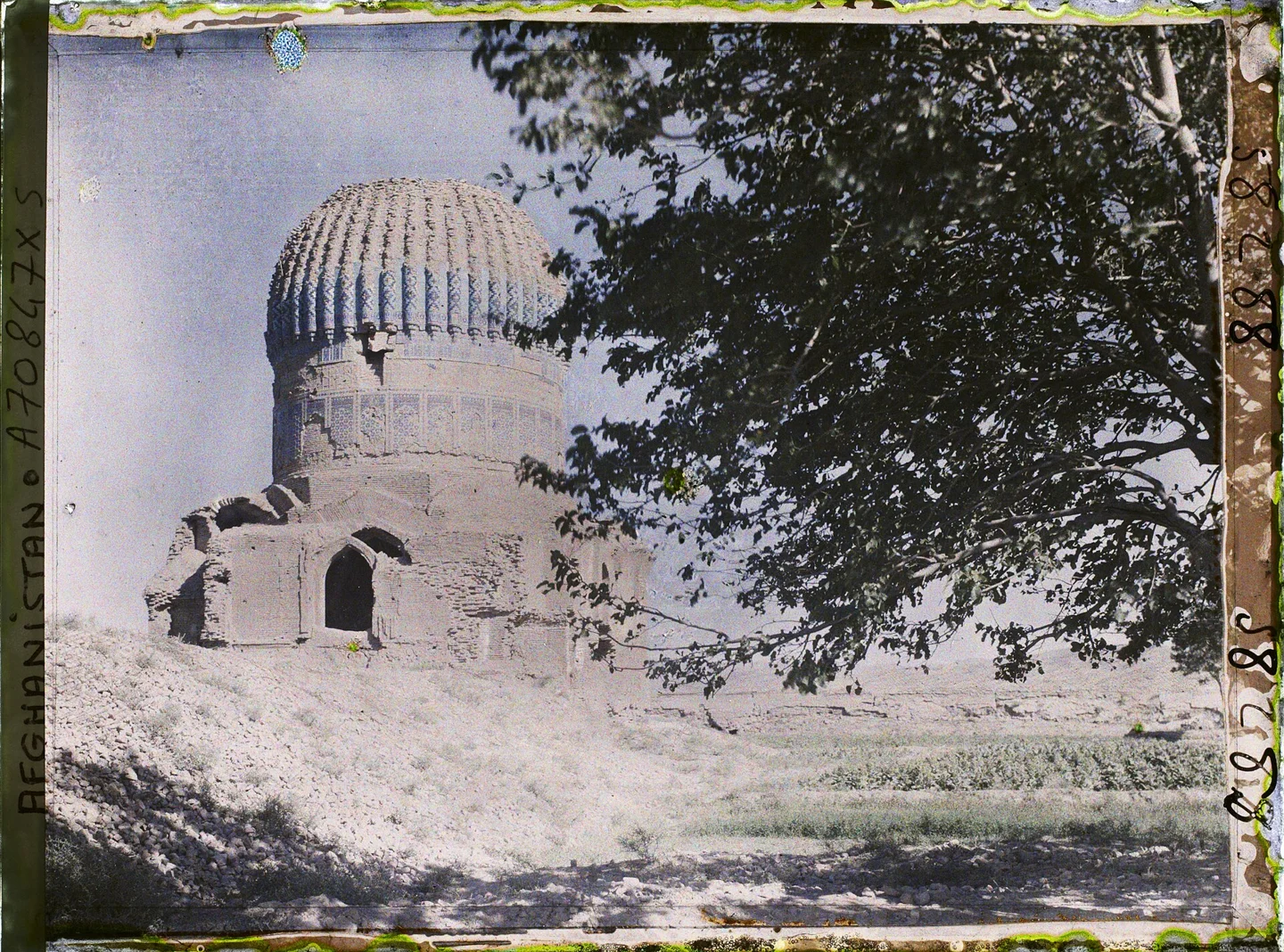
File:Dôme du Mausolée de Goharshad - A70847XS.jpg — Gadmer Frédéric — CC BY-SA 4.0 · WebP / crop

Timur and the dynasty after him
Timur took power in Transoxiana in 1370 and made Samarkand his capital. His death in 1405 did not end the dynasty: descendants ruled through competing branches. The usual span, 1370–1507, is an overall framework, not uninterrupted control of every town. Distinguish an army’s arrival, local submission and lasting administration. Courtly art alone cannot describe the experience of the whole population.
Source: The Met — The Art of the Timurid Period (ca. 1370–1507)
Conquest, violence and displaced craftspeople
Iranica’s historical overview discusses both massacres during the campaigns and the transfer of craftspeople to Samarkand. Prosperity in one centre therefore does not establish peace throughout the realm; capital building could accompany suffering elsewhere. This introduction does not present chroniclers’ large casualty totals as verified statistics. For further research, record the city, event date, author and distance from the events separately.
Samarkand: city, bazaar and observatory
Iranica’s archaeological survey connects the Bibi Khanum mosque and bazaar axis with Samarkand’s transformation under Timur. It also discusses Ulugh Beg’s observatory and its rediscovery in 1908. Standing monuments, excavated remains and written accounts provide different kinds of evidence to compare. A site’s rediscovery date is not its construction date, and everything visible today need not belong to one building phase.
Gowhar Shad: patron and political actor
Gowhar Shad, Shah Rukh’s wife, was more than a name attached to a monument. Iranica’s specialist entry examines her political activity and architectural patronage. The Mashhad mosque was completed in 1418; the Herat mosque and madrasa complex developed over several years. Consider endowment, architect and patron together. One powerful court woman’s position does not establish the rights or daily lives of all women.
Source: Iranica — Gowhar-Shad Agha
Baysunghur and collaborative book production
Baysunghur, son of Shah Rukh and Gowhar Shad, held political responsibilities in Herat while supporting art and calligraphy. Iranica describes him as an accomplished calligrapher and important patron of book production. A luxury manuscript involves scribes, painters, illuminators and other craftspeople: its princely patron does not replace its makers. Separate Ferdowsi’s lifetime from the copying and illustration of Baysunghur’s Shahnameh.
Heritage across present-day borders
Samarkand lies in present-day Uzbekistan and Herat in Afghanistan, within a shared regional cultural history. UNESCO distinguishes ancient and Timurid areas of Samarkand from later expansion. A World Heritage designation does not make every building Timurid. Separate original construction, later changes and heritage status when studying a monument or image. This article is not a travel guide or a report on current site access.
Persian and Chaghatay in a shared cultural setting
The period’s literature should not be confined to one language. Iranica’s Chaghatay entry discusses Herat, Samarkand and Shiraz as literary centres and explains connections between Persian and Chaghatay Turkish. Ali Shir Navai played an important role in Chaghatay writing. A work’s language, its patron’s ancestry and a manuscript’s place of production are separate questions. Persianate culture does not imply one identity shared by every writer and reader.
Husayn Bayqara and different endings
Husayn Bayqara ruled in Herat from 1469, interrupted in 1470, until his death in 1506. Iranica distinguishes this from Muhammad Shaybani’s capture of Herat in 1507. A ruler’s death and his successors’ loss of power are different events. As an optional family activity, choose three dates and one cultural object and find evidence for each. This reading suggestion is not an announced Dorehami event.
Source: Iranica — Hosayn Bayqara
How to explore this period
Read the sources with attention to author, date and evidence. Regional branches may have different time boundaries.
Connect government, succession, towns, architecture, trade, art and everyday life. A ruler does not represent the whole population.
Sources and review date
Sources checked on 21 October 2026.
- The Met — The Art of the Timurid Period (ca. 1370–1507)
- Iranica — Iranian history, Islamic period, page 3
- Iranica — Samarqand: History and Archaeology
- Iranica — Gowhar-Shad Agha
- Iranica — Baysonghor, Ghiyath-al-Din
- UNESCO — Samarkand: Crossroad of Cultures
- Iranica — Chaghatay Language and Literature
- Iranica — Hosayn Bayqara