
Aq Qoyunlu
Aq Qoyunlu were a Turkmen confederation led by the Bayandur family. Uzun Hasan was a major figure; tribal structures and succession conflicts matter to understanding their government.
Fourteenth to early sixteenth centuries
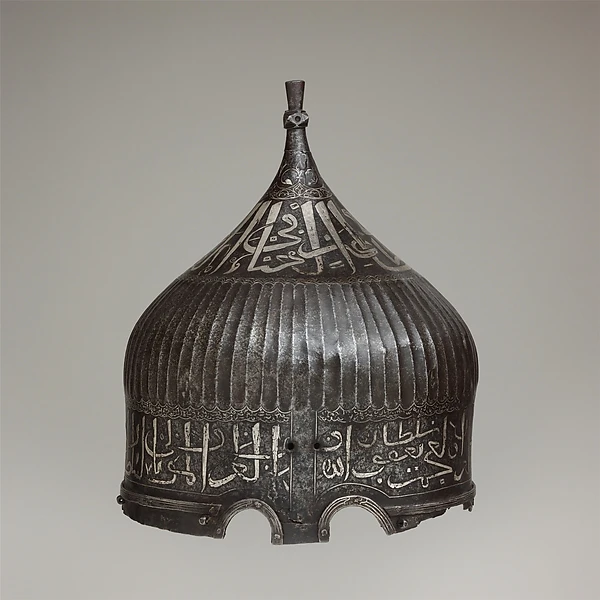
These cultural and symbolic images do not depict Dorehami members or events.
Image and licence
The Met — Turban Helmet, 04.3.211 — The Metropolitan Museum of Art — Public Domain / Open Access · WebP / crop
Confederation, family and territory
Aq Qoyunlu was a Turkmen confederation led by the Bayandur family, developing from eastern Anatolia into a power in western Iran. The name means White Sheep, but its historical explanation is uncertain. The Met gives 1469–1508 for its rule in Iran while also citing the broader span 1378–1508. The formation of a confederation and its acquisition of Iranian territories are different starting points. Its name does not define the identity of every townsperson or villager under its authority.
Source: Iranica — Aq Qoyunlu, The Met — Iran, 1400–1600 A.D.
Uzun Hasan: victories and limits
Jahan Shah’s defeat in 1467 and the Timurid Abu Said’s defeat in 1469 opened the way for Uzun Hasan’s expansion and the move of his government to Tabriz. Defeat by the Ottomans at Otlukbeli in 1473 did not immediately end his rule. Relations with Venice place this rivalry in a wider diplomatic setting. Record battles, changes of capital and the survival of government separately: military victory does not guarantee lasting control everywhere, and defeat on one front need not dissolve an entire state.
Source: Iranica — Aq Qoyunlu, The Met — Iran, 1400–1600 A.D.
Administration and taxation: rules and outcomes
Uzun Hasan retained earlier administrators and administrative arrangements in the Iranian provinces. Tax and trade regulations associated with the Qanun-nama-ye Hasan Padshah also survive in Ottoman sources; this does not preserve all his civil or criminal legislation. A written rule alone cannot establish uniform enforcement. To investigate daily life, ask who collected revenue, who enjoyed privileges and what evidence records the population’s experience. This introduction does not supply unsupported tax rates or claim measurable improvements in welfare.
Source: Iranica — Aq Qoyunlu
Tabriz and the mobile royal camp
Research on Timurid and Turkmen courts places Tabriz’s importance alongside continuing mobile royal encampments. Having a capital did not mean that a ruler and his entire establishment always occupied one palace. The study stresses differences between courts and the difficulty of separating state offices from household duties. A single confident organisation chart would therefore misrepresent the period. The coexistence of city and camp instead opens questions about the connections between artistic patronage, travel, provisioning and political authority.
Source: Iranica — Courts under the Timurid and Turkman dynasties
Yaqub’s helmet: what the object establishes
The Met’s turban helmet, number 04.3.211, bears Sultan Yaqub’s name and is dated 1478–about 1490. The museum identifies its cultural origin as Turkish or Iranian; the inscription does not resolve that uncertainty. Its materials are steel, iron and silver. The name provides a concrete connection with Yaqub, but the catalogue entry alone does not prove that he personally wore it in a particular battle. A photograph of the surviving object also differs from an illustration recreating a historical scene.
Hidayat’s divan and the language of a book
Hidayat’s divan at the Chester Beatty in Dublin, CBL T 401, is dated about 1478. Its museum description links an opening inscription to the library of Sultan Khalil, who ruled briefly that year. The text is in Chagatai Turkish, while the poet’s identity remains uncertain. One manuscript’s language cannot stand for the languages of an entire realm, and a proposed author is not a confirmed identification. Pigments, gold, calligraphy and the small format invite questions about commissioning and reading at court.
Source: Museum With No Frontiers / Chester Beatty — Divan of Hidayat, CBL T 401
One Khamsa and several patrons
Iranica traces a Khamsa of Nezami from the Timurid prince Babur ibn Baysunghur’s commission through Qara Qoyunlu patron Pir Budaq to the Aq Qoyunlu princes Khalil and Yaqub. The book’s passage is more clearly described than the movement of an entire workshop: the author treats the latter as a presumption. Political period boundaries do not automatically divide artistic production. Separate the copying date, painting dates, patrons and later additions when investigating a manuscript made in several stages.
Different endings and continuing legacies
After Yaqub’s death in 1490, succession struggles weakened central authority. Safavid rule in Tabriz in 1501 should be distinguished from later conquests and Baghdad’s transfer in 1508. The Met also identifies contributions from Aq Qoyunlu workshop artists to Safavid painting. For optional family reading, make three columns: political event, place and artistic evidence. This is a suggested exercise, not an announced Dorehami gathering. The article remains a bounded introduction rather than complete biographies of every ruler or a history of every region.
Source: Iranica — Aq Qoyunlu, The Met — Iran, 1400–1600 A.D.
How to explore this period
Read the sources with attention to author, date and evidence. Regional branches may have different time boundaries.
Connect government, succession, towns, architecture, trade, art and everyday life. A ruler does not represent the whole population.
Sources and review date
Sources checked on 22 October 2026.
Related periods to explore
Qara Qoyunlu
Fourteenth and fifteenth centuries
The Safavids
From 1501, with the main period ending in the early eighteenth century