
The Afsharids
Nader Shah founded the Afsharid dynasty. Its power and territory changed after his death; the dynasty’s whole history is not identical to his reign.
1736–1796, with changing territories
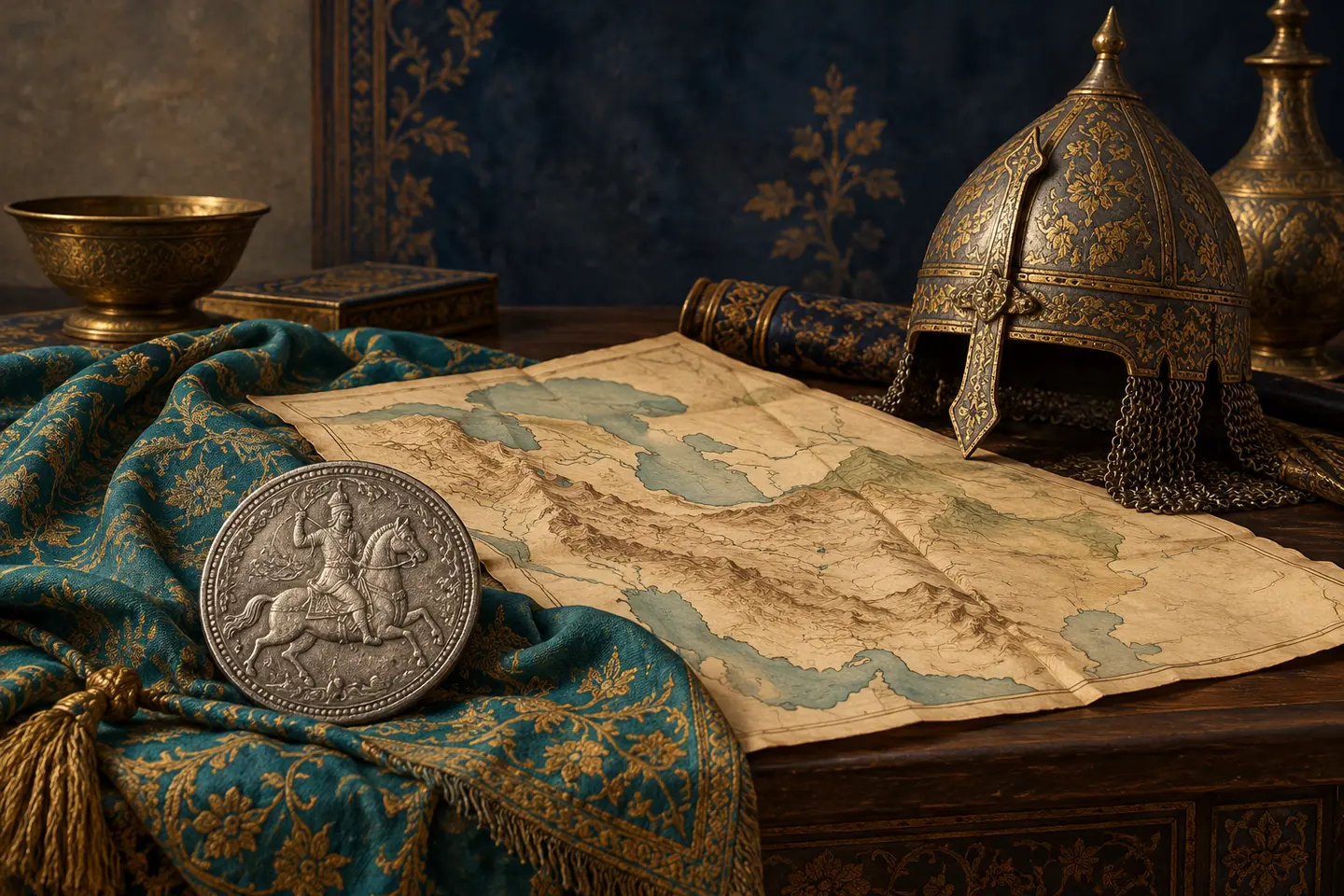
These cultural and symbolic images do not depict Dorehami members or events.
Image and licence
AI-generated symbolic Afsharid study image — OpenAI image generation for Dorehami — Project-generated educational asset · WebP / crop
One name for two different scales
The Afsharids are usually dated 1736–1796, but those sixty years were not one continuous empire. Nader Shah ruled a far-reaching realm from 1736 until his assassination in 1747. Its structure then collapsed rapidly, and the Afsharid state became largely confined to Khorasan. “Afsharid period” can therefore name either Nader’s reign or the political history of Khorasan until its incorporation by the Qajars.
Source: Encyclopaedia Iranica — Afsharids, Encyclopaedia Iranica — Nāder Shah
From Safavid commander to coronation
The collapse of Safavid central authority after Isfahan fell in 1722 opened new struggles for power. Nader came from the Qirqlu branch of the Afshars in northern Khorasan and became Tahmasp II’s principal commander. His victories helped recover territory while also building his personal power. He was crowned in 1736 and founded a new dynasty. This was not a simple, uninterrupted restoration of the same Safavid state.
Army, diversity and the cost of rule
Iranica emphasizes both continuity from Safavid military organization and changes in composition. Tribal cavalry, musketeers, jazayerchi and artillery served in the army, and Nader deliberately assembled forces of varied origins. Such diversity should not be confused with a single shared identity. The cost of the army and repeated campaigns strained taxation and local resources; an account of victories is incomplete without examining economic burden and state violence.
Source: Encyclopaedia Iranica — Army: Afshar and Zand Periods
The 1739 campaign and its human consequences
The 1739 invasion of the Mughal Empire included victory at Karnal and entry into Delhi. Iranica discusses both frontier pretexts and the army’s financial needs, as well as plunder, the Delhi massacre and the transfer of wealth. A purely triumphal account obscures civilian experience, disruption of trade and the movement of troops and assets. Very large totals reported for the booty are historical estimates, not an audited balance sheet.
Source: Encyclopaedia Iranica — India: Afsharid and Zand Relations
Mashhad, Khorasan and an unstable capital
Mashhad was both Nader’s power base and an important symbolic center. Sources mention repairs and additions at the shrine of Imam Reza, construction of a tomb and the concentration of troops and captives in Khorasan. These belong to urban history, but building alone does not demonstrate public prosperity; military population and forced migration could burden local resources. Present-day Mashhad should not be projected directly onto the city of the 1740s.
What can a silver coin establish?
The British Museum attributes silver coin 1906,1107.32 to Nadir Shah, the year 1740 and the Isfahan mint; it records a diameter of 26 millimeters and a weight of 11.51 grams. These facts help with chronology, ruler names and mint networks. One coin does not establish everyday purchasing power, tax levels, circulation across every region or popular consent. The symbolic illustration on this page is not an image of that museum object.
Source: British Museum — Silver coin of Nadir Shah, 1906,1107.32
After Nader: succession and regional powers
Nader’s assassination in 1747 was followed by rivalry among relatives and commanders, military disintegration and territorial separation. Adel Shah and Ebrahim Shah ruled briefly; Shahrokh remained in Khorasan while the Zands rose in the west and the Durranis in the east. Kerman’s history shows that nominal allegiance, refusal to remit taxes and local gubernatorial power could coexist. A ruler list alone does not map real political authority.
Source: Encyclopaedia Iranica — Afsharids, Encyclopaedia Iranica — Kerman in the Afsharid and Zand Period
A reading method and image disclosure
A useful timeline has three rows: before the coronation, Nader’s reign and Khorasan after 1747. For each claim, identify whether the evidence is narrative history, a museum object or scholarly interpretation. This page’s AI-generated image uses a coin, map, textile and equipment as visual symbols; it is not a photograph, an authoritative historical map or an exact reconstruction. The exercise is not an announced Dorehami event and requests no family information.
How to explore this period
Read the sources with attention to author, date and evidence. Regional branches may have different time boundaries.
Connect government, succession, towns, architecture, trade, art and everyday life. A ruler does not represent the whole population.
Sources and review date
Sources checked on 21 October 2026.
Related periods to explore
The Safavids
From 1501, with the main period ending in the early eighteenth century
The Zand dynasty
Middle to late eighteenth century