
The Parthians
The Parthians were a major regional power for centuries. Coins, local remains and relations with Rome are important evidence; power was not uniformly centralized everywhere.
About 247 BCE–224 CE
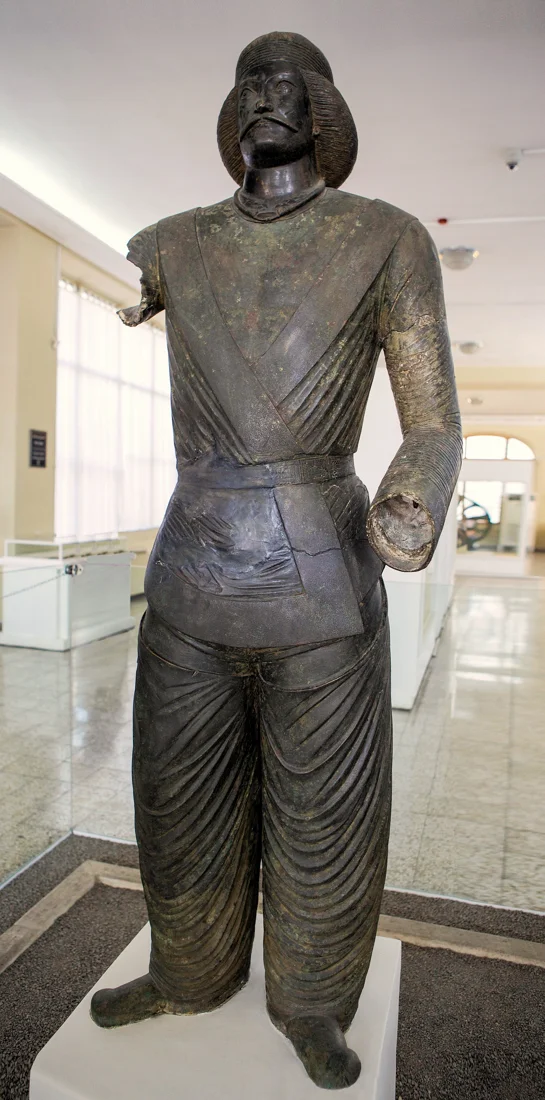

These cultural and symbolic images do not depict Dorehami members or events.
Image and licence
File:Parthian prince, from Sham-Izeh, Malamir, Iran, c.50 BC-AD 150 (cast bronze), Parthian School (250 BC-226 AD) National Museum of Iran, Tehran, Iran.jpg — Ninara — CC BY 2.0 · WebP / crop

File:Shami statue, 1.94 metre-high bronze statue of a Parthian noble, from the sanctuary at Shami in Elymais, Parthian period, dated 50 BC - 150 AD, National Museum of Iran, Tehran, Iran.jpg — Carole Raddato — CC BY-SA 2.0 · WebP / crop

Time frame and uneven evidence
The years 247 BCE–224 CE are a conventional dynastic frame for the Arsacids, not a boundary that began and ended on one day in every city. The order of early kings and periods of internal rivalry are still reconstructed from coins, outside narratives and scattered finds. Greek and Roman writers mainly describe western war and diplomacy, while archaeology, inscriptions and local documents supply regional views. A king’s reign, control of a province and the date of an object should therefore not be treated as the same thing.
Source: Encyclopaedia Iranica — Arsacids ii. The Arsacid Dynasty
Parni, Parthia and the making of a dynasty
Arsaces led the Parni, a group linked to the Dahae confederation, who gained power in Parthia in the mid-third century BCE. The Parni should not be equated with every inhabitant of Parthia or every later subject of the empire. Nor is a simple picture of “steppe nomads” adequate: Iranica points to settled communities, herding, cultivation and irrigation networks in and around the region. After conquest, the new ruler had to govern existing populations and negotiate with their elites. Arsacid identity developed through this political and regional process.
Source: Encyclopaedia Iranica — Arsacids ii. The Arsacid Dynasty
Expansion and several endings to Seleucid rule
The young kingdom first established itself in the northeast. Under Mithridates I, about 171–139/138 BCE, it incorporated Media and Mesopotamia and came to rule major Hellenistic cities. Change had a different date and form in each region; Susa, Media, Seleucia and Persis cannot be explained by one sudden frontier line. Cities, local dynasties and mints could continue operating. “Conquest” marks the beginning of a political relationship, not proof of equally close daily control over every village or the disappearance of earlier cultures.
Source: Encyclopaedia Iranica — Arsacids ii. The Arsacid Dynasty, Encyclopaedia Iranica — Ctesiphon
King of kings, great houses and multiple centres
The great king stood at the apex, but power was negotiated with aristocratic houses, subordinate kings, cities and regional rulers. Recurrent royal dependence on nobles and rivalry among claimants contradict a picture of complete centralization; yet the label “feudal” should not replace specific evidence. The court moved among several centres. Ctesiphon served as a winter residence from Mithridates I to 224, while the Seleucia mint continued and Nisa and Hecatompylus had other roles. “Capital” in this period need not mean one permanent and exclusive administrative centre.
Source: Encyclopaedia Iranica — Arsacids ii. The Arsacid Dynasty, Encyclopaedia Iranica — Ctesiphon
Nisa: fortresses, stores and calendar
Nisa lies at the foot of the Kopet-Dag near modern Ashgabat in Turkmenistan; it should not be placed within present-day Iran without explanation. Old and New Nisa were among the earliest important Arsacid centres and were inscribed by UNESCO in 2007. Mud-brick buildings, storerooms and written pottery fragments provide clues to economic and ritual organization. The remains show interaction between Central Asian and Mediterranean traditions, but the tells’ present appearance results from erosion and is not a direct reconstruction of the ancient city. Nisa’s importance also does not prove that it was the empire’s sole capital for five centuries.
Coins, language and the name Arsaces
Coins can provide dates, mints, royal images and political messages, but they are not a census of language or identity. The Met’s silver drachm names Arsaces I in its inscription although the current ruler is identified as Mithridates; “Arsaces” may have served as a dynastic or throne name. Greek legends on many coins reveal the court’s audiences and broad monetary traditions, but do not establish every subject’s household language. Parthian script also appeared on later coins. Each object should be read with its date, mint, interpretation of the legend and the uncertainty recorded for that item.
Source: The Met — The Parthian Empire (247 B.C.–224 A.D.), The Met — Parthian Silver Drachm
Trade routes and rivalry with Rome
The Arsacid realm lay between Central Asia, the Iranian plateau, Mesopotamia and the Mediterranean, and Parthian merchants could act as intermediaries moving goods east and west. Yet “complete control of the Silk Road” is an oversimplification: there were multiple land routes, Sogdian and other merchant groups participated, and sea routes through the Red Sea and Persian Gulf grew more important in long-distance trade. Roman-Parthian wars sometimes disrupted these networks. Even the motive for Trajan’s campaign in 114 is uncertain; trade, military frontiers and personal prestige have all been proposed.
Source: Encyclopaedia Iranica — Arsacids ii. The Arsacid Dynasty, Encyclopaedia Iranica — Commerce iii. Parthian and Sasanian Periods
The Shami statue, regional variety and the dynasty’s end
The 1.94-metre bronze statue from Shami in Khuzestan is the only known intact monumental cast bronze of the Parthian period and probably dates to the first century CE. The man’s identity, precise date and original context are not secure. The two photographs on this page are present-day views of this one statue in the National Museum of Iran, not two princes or a historical scene. Because Shami lay in Elymais, even the label “Parthian” must allow for regional rule. Ardashir’s victory over the last Arsacid king in 224 ended the dynasty; people, languages, art and institutions did not disappear in a day.
Source: Encyclopaedia Iranica — Arsacids ii. The Arsacid Dynasty, Encyclopaedia Iranica — Shami Statue, Encyclopaedia Iranica — Archaeology iii. Seleucid and Parthian
How to explore this period
Read the sources with attention to author, date and evidence. Regional branches may have different time boundaries.
Connect government, succession, towns, architecture, trade, art and everyday life. A ruler does not represent the whole population.
Sources and review date
Sources checked on 22 October 2026.
- Encyclopaedia Iranica — Arsacids ii. The Arsacid Dynasty
- The Met — The Parthian Empire (247 B.C.–224 A.D.)
- UNESCO — Parthian Fortresses of Nisa
- Encyclopaedia Iranica — Commerce iii. Parthian and Sasanian Periods
- The Met — Parthian Silver Drachm
- Encyclopaedia Iranica — Ctesiphon
- Encyclopaedia Iranica — Shami Statue
- Encyclopaedia Iranica — Archaeology iii. Seleucid and Parthian